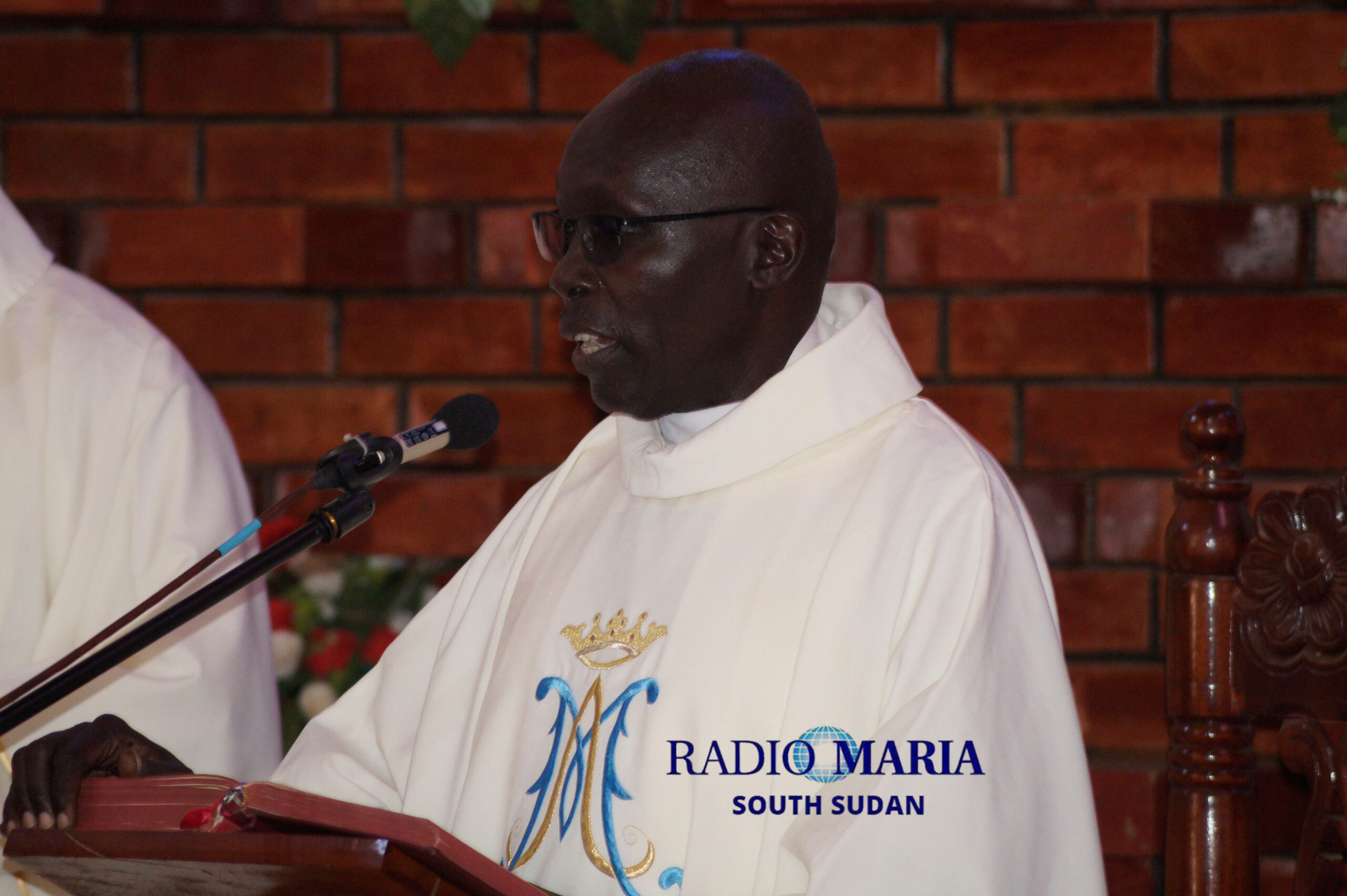
On this important feast, the solemnity of the most holy body and blood of our Lord Jesus Christ, our children are telling us the insight of our faith: that Jesus may stay with us, that Jesus may make us holy, and that Jesus may continue to teach us about his presence in the Holy Eucharist. His presence—fully present in the Eucharist, in his body, in his blood, soul, and divinity—this is our faith. This is the faith of the Catholic Church. This is the faith that, after this, we are going to renew our baptismal promises in, here in the presence of our Lord Jesus Christ, fully God and fully human, for the salvation of our souls.
The sequence that we just heard being sung in Latin was giving us the meaning of this solemnity today. It is telling us that, “Lord, the angel’s food is given to the pilgrim who have striven.” For all those who strive, the angel’s food will be given.
Do you remember when the Canaanite woman came to Jesus and was pleading with him? The disciples came and spoke, and Jesus noted how Gentiles were called “dogs” by those outside the firstborn children of God, meaning the food of the children should not be given to them. Now, in this sequence, we are given a new beginning, a new birth, and a new status so that we may be called children of God through our baptism.
The sequence tells us that truth, “the ancient types fulfilling, Isaac bound, a victim willing.” Isaac was a type of Jesus. When Isaac was to be sacrificed, he was the only son of his father Abraham, and God asked for him to be offered. But then God provided a ram instead of Isaac, because Isaac was not the ultimate fulfillment of the Old Testament. Jesus is.
And when the people of Israel came out of Egypt, God, even in their stubbornness, gave them the bread of the angels to eat. That is why Moses said when he spoke to the people in the first reading, taken from the book of Deuteronomy 8:2-3 and 14-16: “You shall remember all the way which the Lord your God has led you these 40 years in the wilderness, that he might humble you, testing you to know what was in your heart, whether you would keep his commandments or not.”
Did they keep it? They were falling every time, but the Lord kept his love, kept his commandment, and gave them the food of the angels that they may be led. For their stubbornness, they were punished for 40 years to reach the promised land, but the Lord kept his covenant.
For our sins and for our stubbornness, the Lord fulfilled his covenant by bringing to us his only begotten Son, our Lord Jesus Christ. Today, in the Gospel of John, Jesus is telling us: “Truly, truly…” And when he says “truly, truly,” he is affirming exactly who he is. Jesus told us that he is the way, the truth, and the life. If today, here in St. John’s Gospel, he is repeating it truly, “…Truly, truly, amen, amen, listen carefully, my dear brother, my dear sister—you who have been drawn to become a son and a daughter of God. And Jesus is telling us today: ‘Truly, truly, I say to you, unless you eat of the flesh of the Son of Man and drink his blood, you have no life in you.’ Does it sing within you? Does it make sense to you today that on this day the Catholic Church should celebrate the most holy body and blood of our Lord Jesus Christ?
Does it hit you that as you are made sons and daughters, you are called to be part of the people who are partaking of his body and blood? Do you need new life within you? Then on this day of the celebration of Jesus’ presence in the Holy Eucharist—body, blood, soul, and divinity—let your light shine. May the words just now said by our children renew your faith that Jesus may stay with you. By partaking of his body and blood, may he make you holy. Always, as you come to church, may he continue to teach you about the things of heaven, because this food—his body, his blood—is food for our journey, our journey to heaven.
My dear brothers and sisters, the Holy Eucharist has been the mark of our Christian faith. Even from the Old Testament, we see the foreshadowing, and we know that the Christians of the New Testament, from the Acts of the Apostles, gathered to break bread. And as they gathered to break bread, they adored Jesus. They renewed their faith and they called upon him to remain with them so that they might be evangelizers, going out to preach Him who is present in the Holy Eucharist.
Our Christian identity has undergone a number of trials. Christians of old were even stopped from celebrating the Mass. I want to draw your attention to this: if they who went before us held the Mass so dear, we, the Christians of today, on this solemn day of the body and blood of our Lord Jesus Christ, have to say, “Jesus, renew my faith in you, that I may carry the spirit of all the saints, and especially the martyrs who died carrying you.”
One of the best examples we can give here is Saint Tarcisius. In the third century, he was a young man. If we were to count his age, he would be the age of these children in the choir here, these altar servers, these crusaders. Because the elderly were put in prison for the very reason of the Holy Eucharist—for their faith in the Holy Eucharist—this young, energetic acolyte was sent to take the Holy Eucharist to those in prison. Saint Tarcisius did this every Sunday.
Then, one Sunday, he was caught. He was caught by pagan soldiers, a pagan group of people, and was threatened to surrender the Holy Eucharist—to surrender Jesus, in whom he had utmost faith. What he did was grab Jesus, hold Him to his chest, and say, “I will never surrender him.” And because of that, they killed him. They killed him while he was holding the Eucharist. Today, because of his immense love and zeal for the Blessed Sacrament, Saint Tarcisius is honored as the patron saint of altar servers and acolytes. Brothers and sisters, what we see here simply as a piece of bread, our faith tells us is something far greater. Every time we celebrate the Mass on this altar, God is actively at work, performing a continuous miracle so that we—even as sinners—might partake of his body and blood. He does this so that we might become his brothers and sisters, because he said, “I’ve shown you everything. I’ve told you everything that I learned from my father.”
I urge you and plea with you: do not take up the arguments of those who questioned Jesus, asking, “How can this man give us his flesh to eat?” Jesus answers them directly, saying, “Truly, truly, if I do not give you my body to eat and my blood to drink, you will have no life in you.” May these words resonate deep within us today.
Today, we also remember all those who have died for this truth, including the Uganda Martyrs. They died because they believed in the Eucharist. They died because they believed in Jesus and refused to part ways with him. Whether we are alive or dead, we belong to the Lord. When the time comes, let us defend him. Let us open our mouths and our lips to boldly say, “I believe in him.” This is why the Catholic Church teaches that wilfully missing Sunday Mass is a grave sin.
Let us recall one of the most powerful testimonies from the early Church. During the brutal Roman persecution under Emperor Diocletian, a group of saints known as the Martyrs of Abitene in North Africa were arrested for gathering secretly. When the Roman proconsul demanded to know why they disobeyed the imperial decree, they answered with words that should echo in our hearts forever: “Sine dominico non possumus”—”Without the Lord’s Day, we cannot live.” They chose to be murdered and martyred rather than live a life without the Sunday Eucharist.
We must look at our own history and devotion. When we were in Khartoum, almost no Christian remained at home on Sunday. Christians who were forced to work on the Sabbath found the courage to defy those laws, saying, “I will gladly leave this job if you stop me from coming to the Sunday celebration.” Yet today, we are a free nation. We are citizens of South Sudan. We craved to have our own country, and the Lord graciously gave us this land. But tragically, today, a number of us are denying Sunday worship. A number of us are failing to honor Jesus in the Holy Eucharist, even while calling ourselves Catholic Christians. May the bells continue to ring in our ears until we come out to pray: “Jesus, stay with me. Jesus, make me holy. Jesus, teach me always.”
I want to conclude by sharing a beautiful message about Blessed Carlo Acutis, an Italian youth who died of leukemia in 2006 at the tender age of 15. He was a young man who thoroughly understood modern technology. At that young age, he used his computer skills to document and teach the world about Eucharistic miracles, cutting across oceans from Lanciano to South America. Knowing he was close to death, his famous saying was, “The Eucharist is my highway to heaven.” Brothers and sisters, let these children in our choir and our altar servers remind us of Carlo Acutis’ beautiful witness.
Let us learn a profound lesson from this young saint, whose spirit is mirrored in the presence of our children today. Dear brother and sister, love the Eucharist above all else—even above yourself—because it is Jesus Himself. Attend Mass regularly and faithfully. Every time you enter the church doors, let your heart beat with excitement because you are standing face-to-face with the God who redeemed you from your sins. Spend quality time in Eucharistic adoration; we host adoration here every Thursday, yet some of us rush away instead of rushing toward Him.
May this Sunday entirely renew our faith in our Lord Jesus Christ. Let us use our modern technology to evangelize his presence, just like Carlo Acutis did. Strive for holiness in the midst of your ordinary daily life, knowing that your Lord lives. Carry this sentence with you and repeat it always: The Eucharist is my highway to heaven.
Thank you for sharing