 English
 Arabic
 Chinese (Simplified)
 Dutch
Dutch French
 German
 Italian
 Portuguese
 Russian
 Spanish
THE ASCENSION OF THE LORD.
THE ASCENSION OF THE LORD.
60th Word Day of Social Communications
17/05/2026.
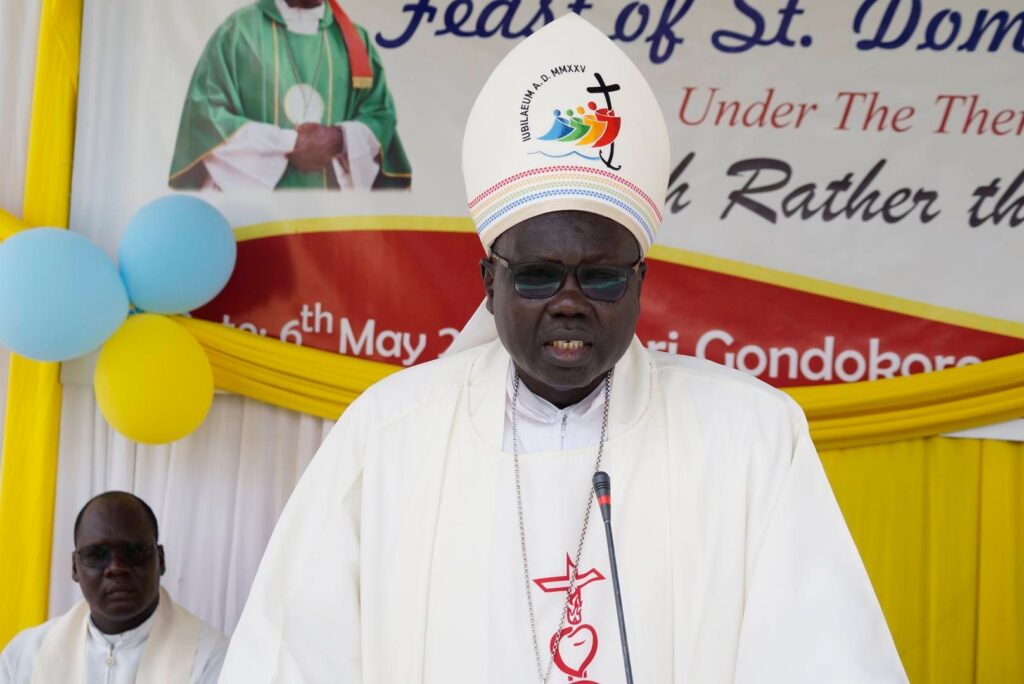
The Catholic Archdiocese of Juba celebrated the Solemnity of Ascension of the Lord and the 60th World day of Social Communications under the theme: Preserving Human Faces and Voices. The mass was officiated by His Lordship Santo Loku Pio, the Auxiliary Bishop of the Catholic Archdiocese of Juba; He encourage people to Hear what the angles said as Christ left, that they should not look up; Christ will return just as they had witnessed him going; nevertheless, the mission given to the Apostles is to go out and preach, baptize all who believed in the name of the Father, and of the son and of the Holy Spirit. this He said is the work given to us; all of us are commissioned.
below is the full text of his homily:
The solemnity of the Ascension signifies the start of the church’s journey. The Church as a moving instrument towards the intended destination to where the father is. With the resurrection, the Church started its long journey to where it belongs and always in the company of the master. That is why it is always said, The Church is Divine, for Christ is its master; and Human for it is entrusted to his Apostles and disciples, to us.
According to St. Augustine, the church recognizes two kinds of life as having been commended to her by God. One is a life of faith, the other a life of vision; one is a life passed on pilgrimage in time, the other in a dwelling place in eternity; one is a life of toil, the other of repose; one is spent on the road and the other in our homeland; one is active, involving labour, the other contemplative, the reward of labour. All of the first life is lived in this world, and it ends here with this imperfect world, while the second life have no end and that was why Christ said to Peter, Follow me.
The Gospel of Mathew (Mt 28:16-20) and the first reading from the Acts of the Apostles (Acts 1:1-11), recounts how Jesus entered the glory of his eternal Father. This feast of the Ascension invites us to look to the earth, to people among whom, we are and called to make present the works of the master. As such, the church of the resurrection is the church that is not to look up, but fully focused on the path and mission to new life as true witnesses. We are given a chance to practice the very charity Christ himself taught us by the help of the Holy Spirit, the teacher and guide.
The 2nd reading from the letter of St. Paul to the Ephesian (Eph. 1:17-23), completes the message that even though we must keep our eyes on earth, we know that human life is not enclosed by it nor does it end within the narrow confines of this world. With Jesus giving the farewell discourse to his disciples as time has come for him to ascend into the new life, after experiencing our own, which landed him on the cross.
The disciples must start moving on with the steps of the new life that he taught them, so that, they too will overcome the cross. In this new journey, the disciples are to receive the Holy Spirit, which will make them more of disciples not only in Jerusalem, Judea and Samaria but to the ends of the earth.
Remember, he told Peter, feed my lambs, sheep; love one another as I loved you. Care for one another, wash the feed of one another, take charge of your calling(vocation) and all that I taught you and you will follow me where ever I go. So, our life is not limited here on earth, we are on move to our Lord’s throne the same way he went. And he said, I will be with you, yes to the end of ages.
As we embrace this mission of being witnesses to the ends of the earth, we must now be able to show the world that Christ is alive in me and so in us. We are called to holiness of life, and so invite others to the holiness as well, ready to preach Christ amidst suffering and death, knowing that the down of the resurrection is awaiting all of us.
The Holy Spirit will help us to reach to the very end of our mission as witnesses to truth, justice, peace, love and care to our fellow humans and to the creation, always producing the fruits of the Holy Spirit. +++
Today will also celebrate, together with the universal people of God the world’s communication day under the theme: “preserving Human Voices and faces”. The Holy Father Pope Leo XIV said, in his message for the 60th world day of social communication and I quote; “Our faces and voices are unique, distinctive features of every person; they reveal a person’s own unrepeatable identity and are defining elements of every encounter with others; faces are Sacred. God who created us in his image and likeness, gave them to us when he called us to life through the word he addressed to us. This word resounded down the centuries through the voices of the prophets, and then became flesh in the fullness of time. We too have heart and seen this word (cf. I Jn. 1:1-3), in which God communicates his very self to us, because it has been made known to us in the voice and face of Jesus Christ the son of God.
Hence; preserving human faces and voices, therefore, means preserving this mark, this indelible reflection of God’s love. The work of communicators, journalists is a work that builds: it builds society, it builds the Church, it makes everyone go forward, provided that it is true. Nevertheless, we need to ask ourselves, are you true? Not only in the things you say, but you inwardly, in your life, you true?” it is a challenge. To communicate what God does with the Son, and the communication of God with the Son and the holy Spirit it must be true. To communicate something divine and of divine nature, the human face and voices. What are you saying about what you see and hear, in you and around you? Are you true?
This celebration of the world communication; is being celebrated at different moment and levels in the history of humanity, with the world still wounded by wars and violence, by shedding of so much innocent blood including our own country. Recently in Lo’bonok, Lirya, Mundri East etc. For the last 13 good years, unnecessary killing of our innocent people has been taking place all-over our country. Most of whom are Women, children’s innocent villagers who don’t know even why they are killed and why they are forced out of their villages to die of hunger elsewhere in the PoCs or the refugee camps and in the bushes. How long should these continue? And why?
Therefore, I would first like to say thank you to all the communication workers who risks their own lives to seek out the truth and to report the horrors of wars and unjust treatment of the human faces. “I wish to remember in prayer all those who have sacrificed their lives in this last year, one of the most lethal for journalists. Let us pray in silence for your colleagues who have signed their service with their own blood”.
I would also want to remember, together with you, all those who are imprisoned merely for having been faithful to the profession of journalist, photographer, video operator, for wanting to see with their own eyes and for trying to report what they have seen. There e many of them; I asked those who have the power to do so, to free all unjustly imprisoned journalists. May a door be open for them too, through which they may return to freedom, because the freedom of journalists increases the freedom of us all. Their freedom is freedom for all of us.
Many do say, that the freedom of the press and freedom of thought be defended and safeguarded along with the fundamental rights to be informed. Free, responsible and correct knowledge is a legacy of knowledge, experience and virtue that must be preserved and promoted. Without this, we risk no longer distinguishing truth from lies; without this. We expose ourselves to growing prejudices and polarizations that destroy the bonds of civil coexistence and prevent fraternity from being rebuilt.
Journalism is more than a profession; it is a vocation and a mission. The role played by Angel Gabriel the heavenly journalist in the holy Scripture. Communicators have the fundamental role for our society today, in reporting facts and in the way in which you report them. We know the language, attitude and tones can be decisive and make the difference between communication that rekindles hope, build bridges and open doors and communications that instead increases division, polarizations and simplifications of reality.
Communication is a peculiar responsibility; it is a precious task. Communications’ tools of trade words and images. But before these are study and reflection, the capacity to see and listen carefully; to place yourselves in the position of those who are marginalized, of those who are neither seen nor heard, and also revive, in the hearts of those who read, listen and look at you, the meaning of good and evil and a nostalgia for the good that you report and by reporting it, bear witness to; and this need courage.
You need to have, and speak of the importance of courage to initiate the change that history demands of us, the change necessary to overcome lies and hatred killing our nations and people. It is true, it takes courage to initiate change which means to have heart; it is that inner drive, that strength that comes from the heart that enables us to face difficulties and challenges without being overwhelmed by fear.
If we fail in this task of preservation, the digital technology threatens to alter radically some of the fundamental pillars of human civilization that at times are taken for granted. Freedom is the courage to choose. Let us take the opportunity today to renew, to rediscover this courage. The courage to free the heart from what corrupts it. Let’s place respect for the highest and most noble part of our humanity at the Centre of the heart, let us avoid filling it with what decays and makes it decay.
We need media literacy, to be educated on the components of information sharing, with well trained and honest information engineers; full of courage, to bring about the communion of enlightened hearts that can feel the face and the voices of others, without turning blind eye to critical issues, complexities and risks.
The Pope concluded by saying; though the digital technology can assist us, let us not renounce our ability to think. Kindly, some journalists end up relaying on the (Al) Artificial intelligence and technology for judgement, that is not enough; Al must be guided by human intelligence not the other way round. Do your works with dedication.
Let us congratulate all our media practitioners, congratulations our journalists, wherever you might be, and may the Lord bless you all.
+In the name of the father and of the Son and of the holy Spirit. Amen. +
Celebrating ‘Coral Jubilee’ – Stephen Ameyu Martin Mulla
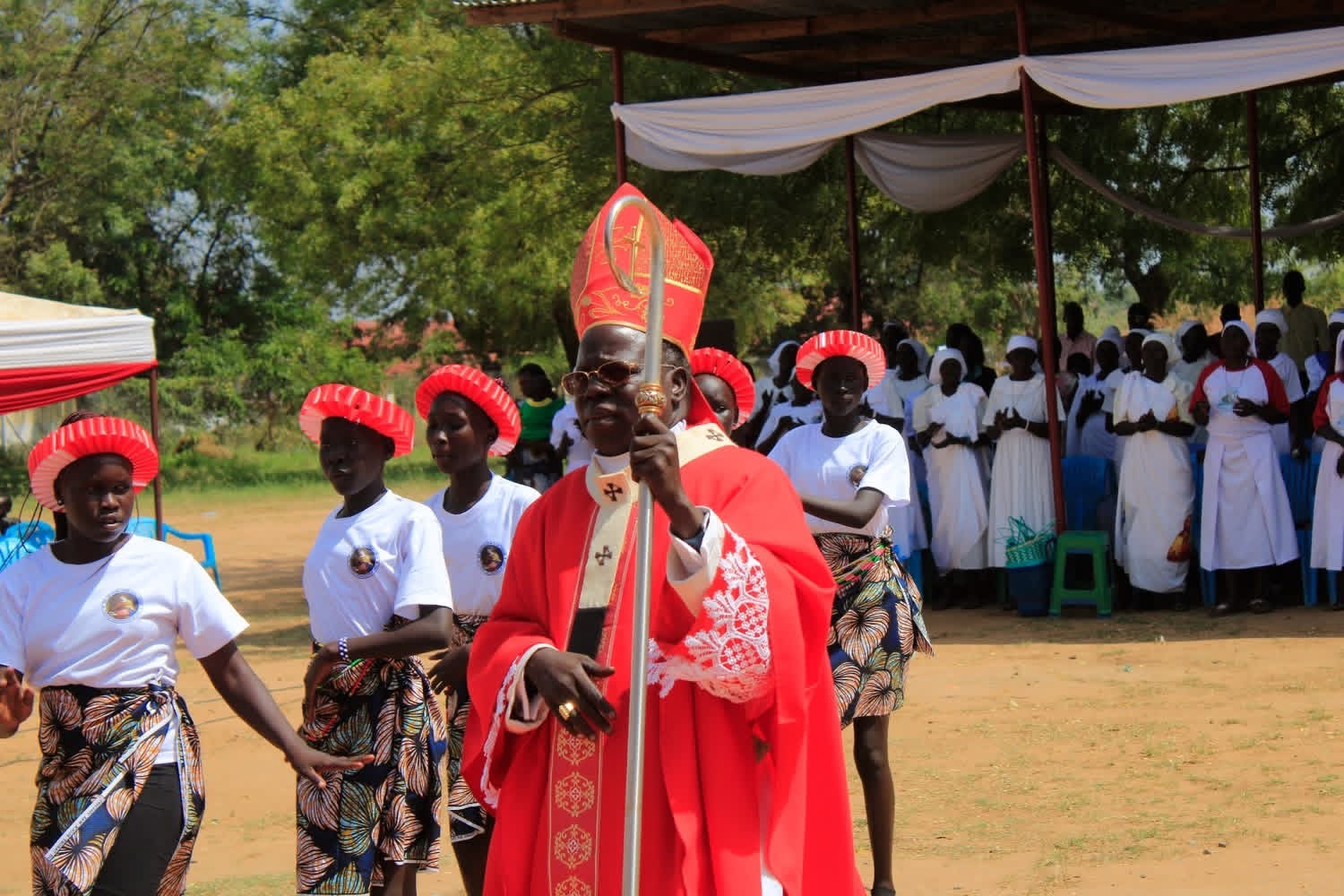
Today, we joyfully celebrate the 35th priestly anniversary of Cardinal Stephen Ameyu Martin Mulla, a man whose life has been a testimony of faith, dedication, and service to God and His people.
Born in 1964 in Ido, Cardinal Ameyu, a Lotuko, son of Martin Mulla and Elisabeth Ibalu. His journey of faith began early when he was baptized in 1969 by catechist Marchello T. Tio. From his foundational years at Langaro Primary School (1971) and Ribok Primary School (1972–1974), his path steadily reflected a growing commitment to his calling.
In 1978, he attended Junior Seminary in Torit, continuing later to Wau Senior Seminary in 1981. His formation deepened at the Major Seminary in Bussere, Munuki, and Khartoum, where he completed his theological studies and graduated with a Bachelor’s Degree in Theology (cum laude).
On April 21, 1991, he was ordained to the priesthood for the Diocese of Torit by Archbishop Gabriel Zubeir—a defining moment that marked the beginning of his lifelong mission in the vineyard of the Lord.
Cardinal Mulla’s service has been rich and impactful. He began his pastoral ministry at St. Matthew’s Cathedral, serving as priest in charge of Shendi, Jebel Awlia, and Kamlin centers. In 1992, he served as assistant parish priest in Atbara, before becoming parish priest of Shendi.
His desire for deeper theological understanding led him to Rome in 1993, where he pursued advanced studies. He returned in 1997 with a Doctorate in Sacred Theology, and generously shared his knowledge as a professor at St. Paul’s National Major Seminary, helping to form future generations of priests.
Over the years, his leadership and commitment have seen him rise in service to the Church, now serving as a Cardinal—continuing to shepherd God’s people with wisdom, humility, and a deep sense of mission.
Today, as we celebrate his anniversary, we honor not just the years of his priesthood, but the lives he has touched, the faith he has strengthened, and the hope he continues to inspire.
May God continue to bless Cardinal Stephen Ameyu Martin Mulla with good health, renewed strength, and deeper joy in his calling. May his priesthood remain a guiding light for many for years to come.
Happy Priestly Anniversary!
HOMILY OF HIS HOLINESS POPE LEO XIV
Esplanade of Saurimo (Saurimo)
Monday, 20 April 2026
Dear brothers and sisters,
In every part of the world, the Church lives as a people who walk as disciples of Christ, our brother and Redeemer. He, the Risen One, illumines for us the path to the Father and with the strength of the Spirit he sanctifies us so that we may transform our way of life in conformity with his love. This is the Good News, the Gospel that courses through our veins like blood, sustaining us on the journey. A journey that has brought me here with you today! In the joy and beauty of our gathering, united in the name of Jesus, let us listen with open hearts to the Word of salvation for it helps us reflect on the motive and purpose for which we follow the Lord.
Indeed, when the Son of God became man, he performed striking miracles in order to manifest the will of the Father: he made light shine in the darkness by giving sight to the blind, he gave a voice to the oppressed by loosening the tongues of the mute, he slaked our thirst for justice by multiplying bread for the poor and weak. Anyone who heard about these works set out in search of Jesus. At the same time, the Lord looks into our heart and asks us whether we seek him out of gratitude or for our own self-interest, with calculation or with love. In fact, he said to those who were following him: “You are looking for me, not because you saw signs, but because you ate your fill of the loaves” (Jn 6:26). His words reveal the designs of those who do not want to encounter a person, but want to consume things. The crowd sees Jesus as means to an end, a provider of services. If he had not given them something to eat, his actions and teachings would not have interested them.
This happens when genuine faith is replaced with superstitious practices, in which God becomes an idol that is sought only when it is advantageous to us and only for as long as it is. Even the most beautiful gifts of the Lord, which are always for the care of his people, become a pretext, a prize or a bargaining chip, and are misinterpreted by those who receive them. The Gospel account, then, helps us to understand that there are erroneous motives for seeking Christ, particularly when he is considered to be a guru or a good luck charm. Even the motivation of the crowd is inadequate: they were not seeking a teacher whom they love, but a leader to applaud for their own advantage.
How different is Jesus’ attitude toward us. Yet, he does not reject this insincere search, but encourages its conversion. He does not dismiss the crowd, but invites everyone to examine what stirs in our hearts. Christ calls us to freedom: he does not want servants or clients, rather he seeks brothers and sisters to whom he can totally dedicate himself. To respond with faith to this love, it is not enough to hear Jesus speak: one must accept the meaning of his words. Neither is it enough to see what Jesus does: one must follow and imitate him. When in the sign of shared bread we see the will of the Savior, who gives himself for us, only then do we draw closer to a true encounter with Jesus, which become discipleship, mission and service.
The admonition that the Lord directs to the crowd is thus transformed into an invitation: “Do not work for the food that perishes, but for the food that endures for eternal life” (Jn 6:27). With these words, Christ expresses his true gift to us: he does not call us to be disinterested in our daily bread, which he multiplies in abundance and teaches us to ask for in prayer. On the contrary, he teaches us the correct way to search for the bread of life, food which sustains us forever. The desire of the crowd receives a much greater and more surprising response: Jesus does not give us food that passes away, but bread that lasts because it is the food of eternal life.
His gift sheds light on our current situation. We can see today how the hope of many people is frustrated by violence, exploited by the overbearing and defrauded by the rich. Consequently, when injustice corrupts hearts, the bread of all becomes the possession of a few. In the face of these evils, Christ hears the cry of the people and renews our history by lifting us up from every fall, comforting us in every suffering and encouraging us in our mission. Just as the Eucharist is the living bread that he never ceases to give us, so too his history knows no end. For this reason, the risen One opens up our lives through the power of his Spirit and removes the end of our history, that is death. Christ lives! He is our Redeemer. This is the Gospel that we share, making all the people of the earth our brothers and sisters. This is the proclamation that transforms sin into forgiveness. This is the faith that saves life!
The Easter witness, therefore, certainly pertains to Christ, the crucified one who is risen, but it also pertains even to us because in him the proclamation of our resurrection finds its voice. We did not come into the world to die. We were not born to become slaves either to the corruption of the flesh or that of the soul: every form of oppression, violence, exploitation and dishonesty negates the resurrection of Christ, the supreme gift of our freedom. This liberation from death, in fact, does not happen only at the end of our days, but every day of our lives. What must we do to welcome such a gift? The Gospel itself teaches us: “This is the work of God, that you believe in him whom he has sent” (Jn 6:29). Yes, let us believe! Today, let us say it together with strength and with gratitude to you, Lord Jesus. We want to follow you and serve you in our neighbor: your word is our rule of life, the measure of truth.
“Happy are those who walk in the law of the Lord” (Ps 119/118:1). This is the Psalm we sang. Dear friends, it is the Lord who marks for us the path for this journey, not our exigencies, nor the current fashion. For this reason, in light of our discipleship the ecclesial journey is a “synod of resurrection and hope,” which Saint John Paul II affirmed in his Apostolic Exhortation on Africa (Ecclesia in Africa, 13). Let us proceed in this wise direction! With the Gospel in your heart, you will have courage in the face of difficulties and disappointments: the way that God has opened for us, never fails. Indeed, the Lord always walks with us, so that we may continue on his path. Christ himself guides and strengthens our journey, a journey that we want to learn to live more and more as it should be, that is in a synodal manner.
In this regard, “The Church proclaims the Good News of Christ not only by the proclamation of the Word which she has received from the Lord, but also by the witness of life, thanks to which Christ’s disciples bear witness to the faith, hope and love which dwell in them” (ibid., 55, 55). Sharing the Eucharist, the bread of eternal life, we are called to serve our people with a dedication that lifts up all who have fallen, rebuilds whenever violence destroys and shares with joy our fraternal bonds. Through us, the initiatives of divine grace bear good fruit especially in adversity, as the example of the first martyr Stephen shows us (cf. Acts 6: 8-15).
Dear friends, the witness of the martyrs and of the saints encourages us and pushes us onto a path of hope, reconciliation and peace, along which the gift of God becomes the responsibility of the headof the household, in the Christian community, in civil society. Travelling together, in the light of the Gospel, the Church in Angola grows according to the spiritual fruitfulness that begins from the Eucharist and continues in the integral care of each person and of the entire people. In particular, the vitality of the vocations that you experience is a sign that you are responding to the Lord’s gift, which is always abundant for those who welcome it with pure hearts. Thanks to the Bread of Life, which we share today, we can continue on the journey of the whole Church, which has as its destination the Kingdom of God, whose light is faith and whose lifeblood is charity.